
Four Theoretical Frameworks
Competing Values
- Public values can be grouped in three categories: general social values (order and individualism), democratic values (liberty, equality, fraternity), and economic values (efficiency, economic growth, quality) (p. 301).
- Values are in all education policies, but importance can change over time.
- One two or three values can be dominant at one time. It takes 40-years for realignment to happen.
Lowi’s Policy Types
- Typology of policies: distributive, regulatory, and redistributive.
- Historical periods impact the policy types that are preferred during that time.
- To understand policy shifts it is important to look at historical periods.
Institutional Choice
- Compare and contract school systems can be done using five types of institutions: bureaucracy, legalization, professionalization, politics, and the market.
- All systems include all five types, but one or two shape the organization.
- Used to compare school systems across countries. Also used to compare school systems at various historical periods in the U.S.
International Convergence
- Educational systems around the world are becoming more similar in structure, curriculum and educational goals (p.303).
- Cross-national influence occurs through nations visiting other nations to view school systems
- World’s economies become interconnected and unable to avoid international influence
Three Categories of School Reform
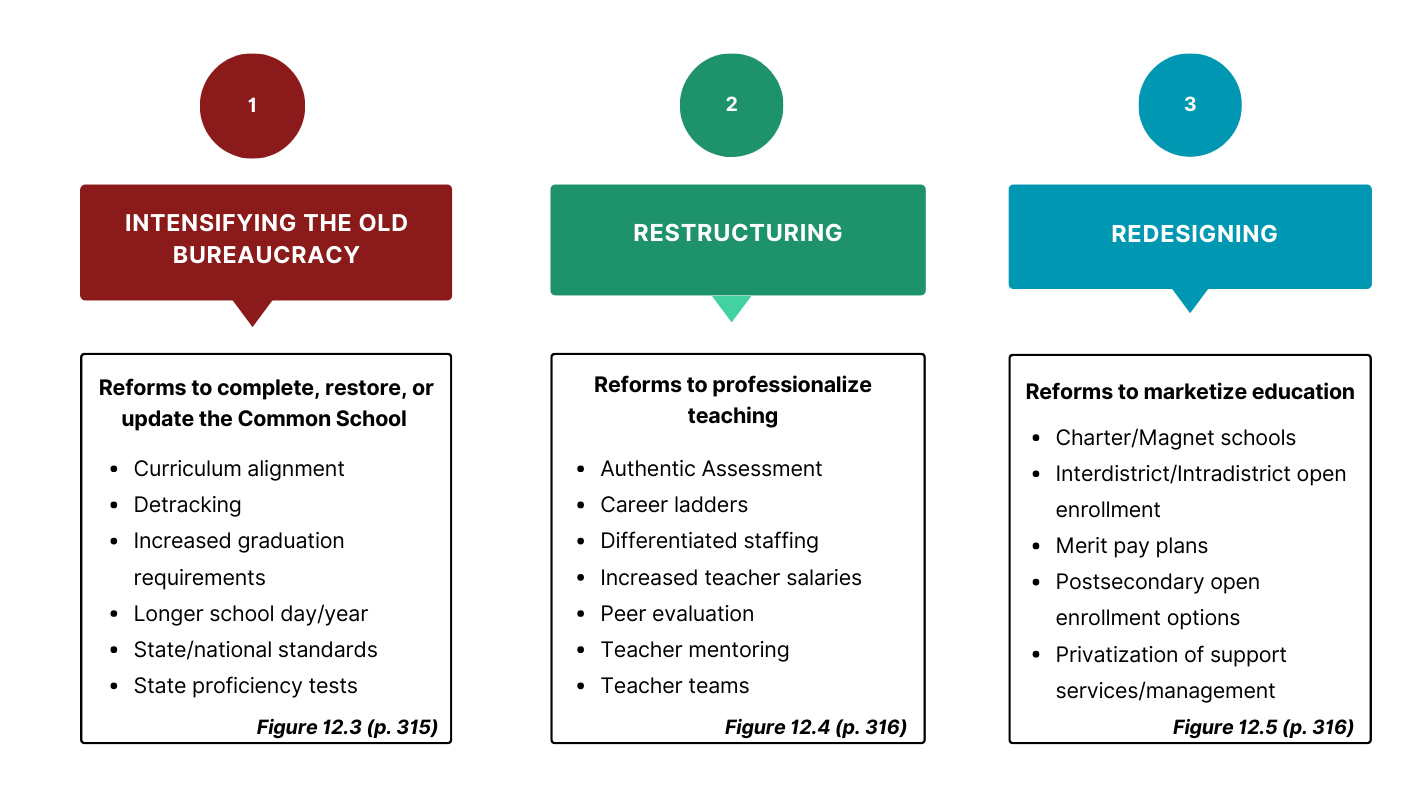
Three broad categories of school reform were developed by Joseph Murray (1990).
Looking Back on No Child Left Behind
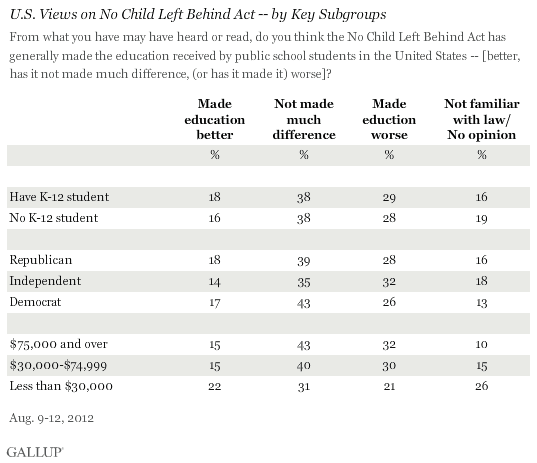
The No Child Left Behind (NCLB) Act mandated that states receiving federal funding through the Elementary and Secondary Education Act (ESEA) create academic standards, implement an assessment system aligned with these standards, and administer tests in reading and mathematics to evaluate whether students are achieving the set standards (Fowler, 2013). below are the results from a Gallup survey from 2009 on views of NCLB.
References
Fowler, F. C. (2013). Policy studies for educational leaders: An introduction. Prentice Hall.
Gallup. (2012). No Child Left Behind rated more negatively than positively. https://news.gallup.com/poll/156800/no-child-left-behind-rated-negatively-positively.aspx
 deshawnamccray.me