Chapter 6 & 7 Overview
Chapter 6
“Regardless of the difference among psychological perspectives on learning, an underlying assumption of most is that instruction will bring about learning” (Reiser & Dempsey, 2017, p. 52). There have been distinctions between “learning as an instructed process and learning as a cultural process” (Reiser & Dempsey, 2017, p. 52). Culture plays a role in the learning process. People bring their cultural experiences and social norms into the classroom and learning experiences (Reiser & Dempsey, 2017).

Chapter 7
Constructivism is a common term heard within K-12 education (Reiser & Dempsey, 2017). Basic principles of constructivism include: active process of meaning-making, cognitive conflict or challenge, and learning as social activity” (Reiser & Dempsey, 2017, p. 61).
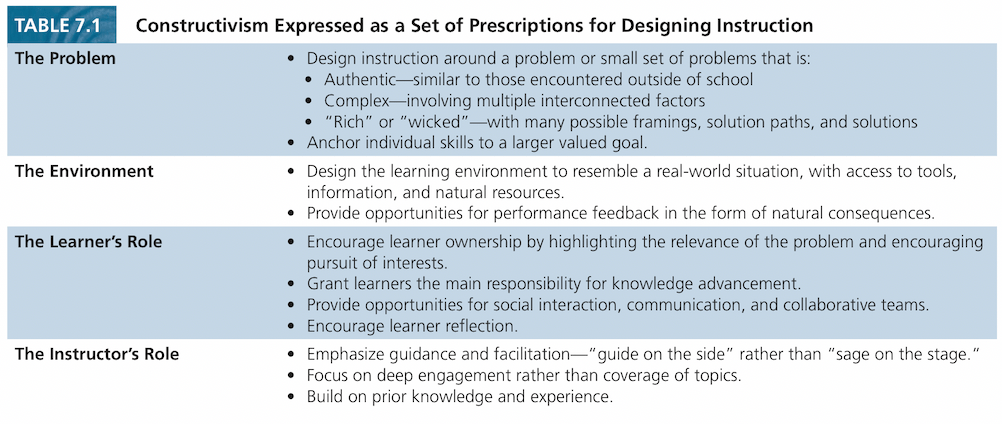
Constructivism puts the job of learning on the learners rather than the teacher. There are some questions to consider such as:
- Are the learners prepared?
- Motivated and emotionally mature?
- Prior knowledge to handle the environment?
- Adequate access to information?
In addition to the concerns about constructivism, there are situations when constructivism is not the best approach:
- Content consist of technical materials with fixed known rules
- High stakes exam curriculum
- Short time frame for preparation
- environment is not learner-centered
Reference
Reiser, R.A. & Dempsey, J.V. (2017). Trends and issues in instructional design and technology. (4th. ed.). Pearson: Boston, MA.
 deshawnamccray.me